
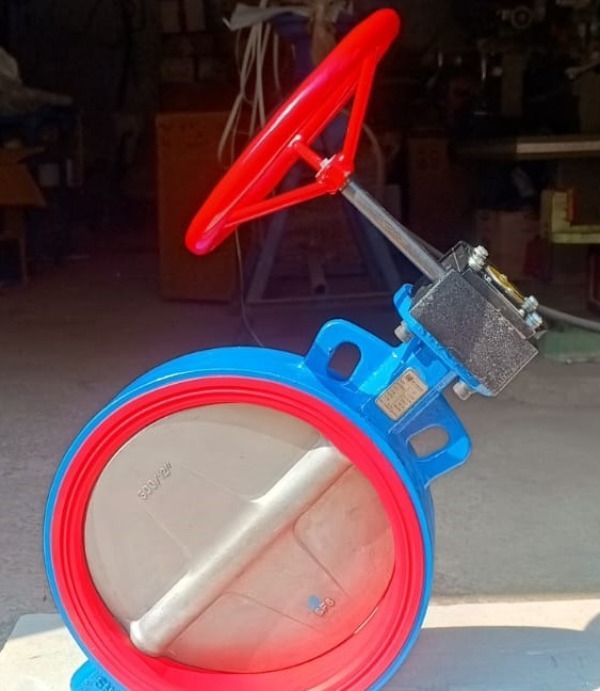
Butterfly valves are quarter-turn rotational motion valves used to stop, regulate, or start fluid flow. They are characterized by a circular disc that rotates on a central axis, offering a compact and cost-effective alternative to bulkier gate or ball valves. Types of Butterfly Valves: Wafer Type: The most common and cost-effective design. It is sandwiched between two pipe flanges using long bolts that encircle the valve body. It is ideal for space-constrained environments but cannot be used for end-of-line service. Lug Type: Features threaded metal 'lugs' on the body. This allows for the removal of piping from one side without disturbing the other, making it suitable for system isolation and end-of-line service. Double Flanged: Includes integral flanges on both ends of the valve body. These are typically used for large-diameter pipelines and heavy-duty industrial applications where a secure, bolted connection is paramount. Concentric (Zero Offset) Type Butterfly Valves Double Eccentric Type Butterfly Valves Triple Offset Type Butterfly Valves Seat Materials The choice of seat material determines the valve’s temperature and chemical compatibility: EPDM: Excellent for water and steam; temperature range of -30°F to 225°F. Buna-N (Nitrile): Best for oils, fuels, and hydraulic fluids; limited to 180°F. PTFE (Teflon): Highly chemical resistant and low friction; suitable for -50°F to 400°F. Metal-to-Metal: Essential for high-temperature and high-pressure steam or abrasive media. Butterfly valves provide several strategic advantages for industrial designers: Efficiency: They offer a high Cv value (flow coefficient), meaning they provide minimal resistance to flow compared to other valve types. Actuation Versatility: They are easily paired with manual levers, gear operators, or pneumatic/electric actuators for automated control. Sustainability: Because they are lightweight and require less raw material (metal) to manufacture than gate valves, they have a lower carbon footprint and reduced shipping costs. Low Maintenance: The simple internal structure with fewer moving parts reduces the frequency of repairs and total cost of ownership.


This is your website preview.
Currently it only shows your basic business info. Start adding relevant business details such as description, images and products or services to gain your customers attention by using Boost 360 android app / iOS App / web portal.
Ultimate Guide to Butterfly Valves: Types, Industrial Applications, and Technical Specifications.
2026-05-04T10:26:36
Butterfly valves are quarter-turn rotational motion valves used to stop, regulate, or start fluid flow. They are characterized by a circular disc that rotates on a central axis, offering a compact and cost-effective alternative to bulkier gate or ball valves. Types of Butterfly Valves: Wafer Type: The most common and cost-effective design. It is sandwiched between two pipe flanges using long bolts that encircle the valve body. It is ideal for space-constrained environments but cannot be used for end-of-line service. Lug Type: Features threaded metal 'lugs' on the body. This allows for the removal of piping from one side without disturbing the other, making it suitable for system isolation and end-of-line service. Double Flanged: Includes integral flanges on both ends of the valve body. These are typically used for large-diameter pipelines and heavy-duty industrial applications where a secure, bolted connection is paramount. Concentric (Zero Offset) Type Butterfly Valves Double Eccentric Type Butterfly Valves Triple Offset Type Butterfly Valves Seat Materials The choice of seat material determines the valve’s temperature and chemical compatibility: EPDM: Excellent for water and steam; temperature range of -30°F to 225°F. Buna-N (Nitrile): Best for oils, fuels, and hydraulic fluids; limited to 180°F. PTFE (Teflon): Highly chemical resistant and low friction; suitable for -50°F to 400°F. Metal-to-Metal: Essential for high-temperature and high-pressure steam or abrasive media. Butterfly valves provide several strategic advantages for industrial designers: Efficiency: They offer a high Cv value (flow coefficient), meaning they provide minimal resistance to flow compared to other valve types. Actuation Versatility: They are easily paired with manual levers, gear operators, or pneumatic/electric actuators for automated control. Sustainability: Because they are lightweight and require less raw material (metal) to manufacture than gate valves, they have a lower carbon footprint and reduced shipping costs. Low Maintenance: The simple internal structure with fewer moving parts reduces the frequency of repairs and total cost of ownership.
2026-05-04T10:26:36


Keywords
- Butterfly Valve Manufacturer in Tamilnadu
- Butterfly Valve Manufacturer in Hyderabad
- Butterfly Valve Manufacturer in Gujarat
- K-TECH FLUID CONTROLS
- Butterfly Valve Manufacturer in INDIA
- butterfly valve types wafer lug double flanged
- concentric zero offset butterfly valve
- double eccentric triple offset butterfly valves
- butterfly valve seat materials epdm buna-n ptfe metal-to-metal
- industrial butterfly valve actuation and control options
Submit Your Enquiry